
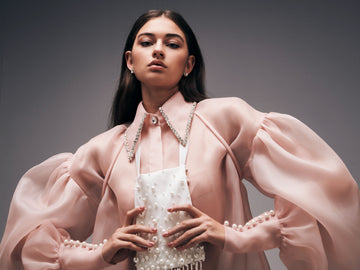

The Back of the Dress
Sometimes, the back is the dress.
We tend to meet a dress from the front.
It’s the obvious place to begin: the neckline, the shape, the way it sits on the body. It’s what you see first on a hanger, what catches your eye in a photograph, what usually makes you stop scrolling.
But turn around.
Suddenly, the same dress can feel completely different.
A low back changes the mood. A slit appears only when you walk. Ruching gathers in a way you hadn’t noticed from the front. A tiny detail, almost hidden, becomes the thing you remember.
A good dress should have something to say when you’re walking away, too.
At ONORI, some of our favourite details are the ones you might not notice immediately. They sit quietly within the silhouette, waiting for movement to bring them to life. A seam placed just so. A soft gathering at the waist. A delicate rose at the hem. A glimpse of skin between layers of fabric.
They are details designed to be discovered rather than announced.
The beauty of a second look
There is something particularly appealing about clothes that reveal themselves slowly.
Perhaps it comes from our fascination with vintage fashion. There was a time when dressing well was less about making an instant statement and more about the entire picture. A dress was considered from every angle because a woman was never expected to stand still in it.
She walked. She sat. She danced. She turned to speak to someone.
The dress had to keep up.
That idea still feels relevant. In fact, perhaps more so now. We photograph clothes constantly, but a photograph only captures one moment. A garment has a much longer life than that single image.
The back is where you see that life.
Made for movement
Think about the moment a woman leaves a restaurant.
Her dress moves differently than it did when she first arrived. The skirt catches behind her. The slit opens and closes with each step. You notice the back of the silhouette, the way the fabric falls, perhaps a detail you hadn't seen all evening.
That is the part of fashion we find interesting.
Not just how a garment looks, but how it behaves.
Construction plays a huge part in this. The placement of a seam, the weight of a fabric, the amount of gathering, the proportion of a skirt—all of these decisions determine what happens when the body starts moving.
It is easy to overlook this when looking at a finished piece. The best construction often looks effortless.
But effortless is rarely accidental.
The details worth looking twice for
Sometimes it is the smallest detail that changes everything.
A miniature rose placed at the centre of a hem.
A sheer layer falling from the hip.
A back that dips just a little lower than expected.
A line of ruching that follows the body instead of sitting perfectly straight.
None of these details need to dominate a look. They simply give you another reason to look.
And perhaps that is what makes them feel modern.
We aren't interested in adding details simply because a garment needs them. We want every element to have a reason for being there—to flatter the body, change the movement, add a little surprise, or simply make the piece more enjoyable to wear.
What you remember
The most memorable clothes are not always the most complicated.
Sometimes you remember the dress because of the way it moved.
Sometimes it is the back.
Sometimes it is the tiny detail you noticed only after the woman had already walked past you.
That, to us, is the pleasure of getting dressed. There should always be something slightly unexpected—a detail that belongs to the wearer as much as it belongs to the garment.
At ONORI, we design with the whole silhouette in mind. The entrance, the movement, the turn, and yes, the exit.
Because a dress shouldn't stop being interesting once you've seen the front.
Sometimes, the best part is the part you see last.
-ONORI